Traveling with kids can feel overwhelming—juggling routines, learning needs, and meaningful family time while constantly on the move. If you’re searching for practical ways to support your child’s growth without sacrificing adventure, this article is designed for you. We’ll explore how to maintain stability on the road, create flexible routines, and incorporate cognitive development activities for kids into everyday travel experiences.
From airport layovers to long road trips and extended stays abroad, you’ll discover strategies that blend child development principles with real-world travel scenarios. Our guidance is grounded in research-backed parenting approaches and firsthand experience observing how children adapt, learn, and thrive in dynamic environments.
By the end, you’ll have actionable tools to turn every journey into an opportunity for connection, learning, and confident parenting—no matter where your travels take you.
Building a Brilliant Mind: Simple Ways to Boost Your Child’s Brainpower
Let’s be honest: the pressure to “optimize” your child’s brain can feel exhausting. Between pricey toys and rigid schedules, it’s easy to wonder if you’re doing enough. Meanwhile, you’re just trying to pack a suitcase. The truth? cognitive development activities for kids don’t require fancy tools—just intention.
Simple Shifts, Big Gains
Instead of overhauling your routine, try this:
| Moment | Brain Boost |
|---|---|
| Airport wait | Memory games |
| Grocery run | Counting challenges |
| Road trip | Story-building |
Research shows playful learning strengthens problem-solving and memory (Harvard Center on the Developing Child). So yes, conversation counts. And thankfully, it travels well.
The Foundation: What Is Cognitive Development and Why It Matters
Cognitive development is simply the growth of a child’s ability to think, reason, and understand the world around them. It’s how babies turn into toddlers who ask “why?” 400 times a day (and somehow aren’t satisfied with any answer). In short, it’s the brain learning how to brain.
At its core, cognitive development includes a few key skills:
- Memory – storing and recalling information (like where they hid your phone).
- Attention – focusing long enough to learn something new.
- Problem-solving – figuring out puzzles, conflicts, or how to reach the cookie jar.
- Language – understanding and using words to communicate.
These skills form a “mental toolkit” for life. Strong cognitive abilities support academic success, confident decision-making, and lifelong learning. Whether through everyday conversations or intentional cognitive development activities for kids, you’re helping build the foundation for everything that follows. Think of it as upgrading their internal software—no Wi-Fi required.
Playful Learning: Cognitive Activities for Toddlers (Ages 1–3)

Between ages one and three, little brains are buzzing with new connections. At this stage, sensory play—activities that engage touch, sight, sound, taste, and smell—literally strengthens neural pathways (Harvard Center on the Developing Child). When toddlers squish soft playdough or hear blocks clatter across the floor, those sights and sounds help wire the brain for future learning. In other words, messy hands often mean growing minds.
Activity 1 – Shape Sorters & Stacking Blocks
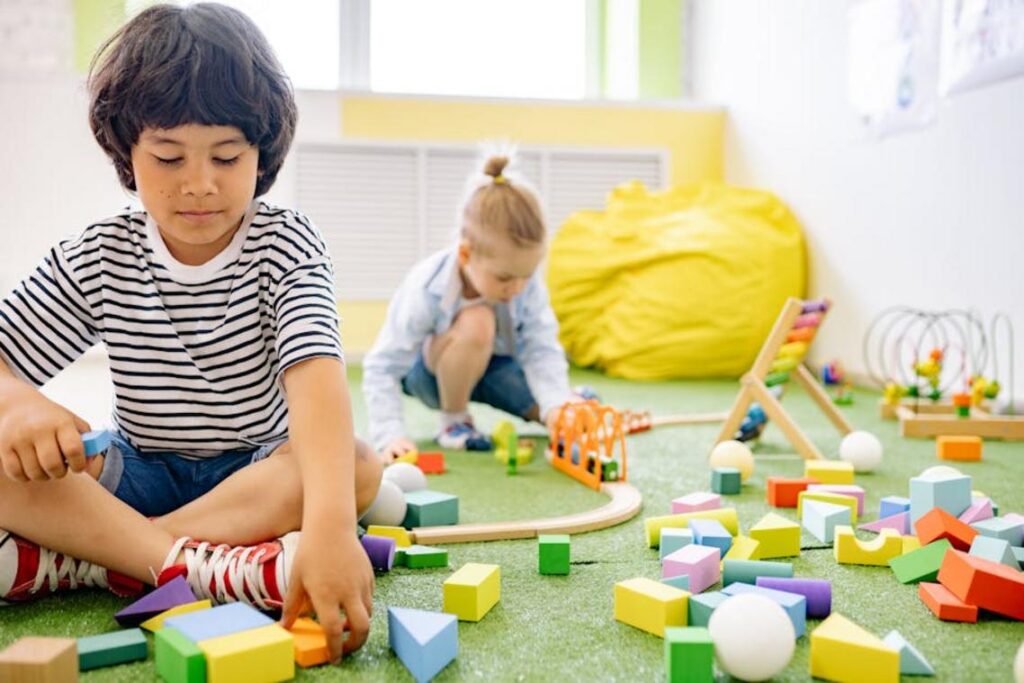
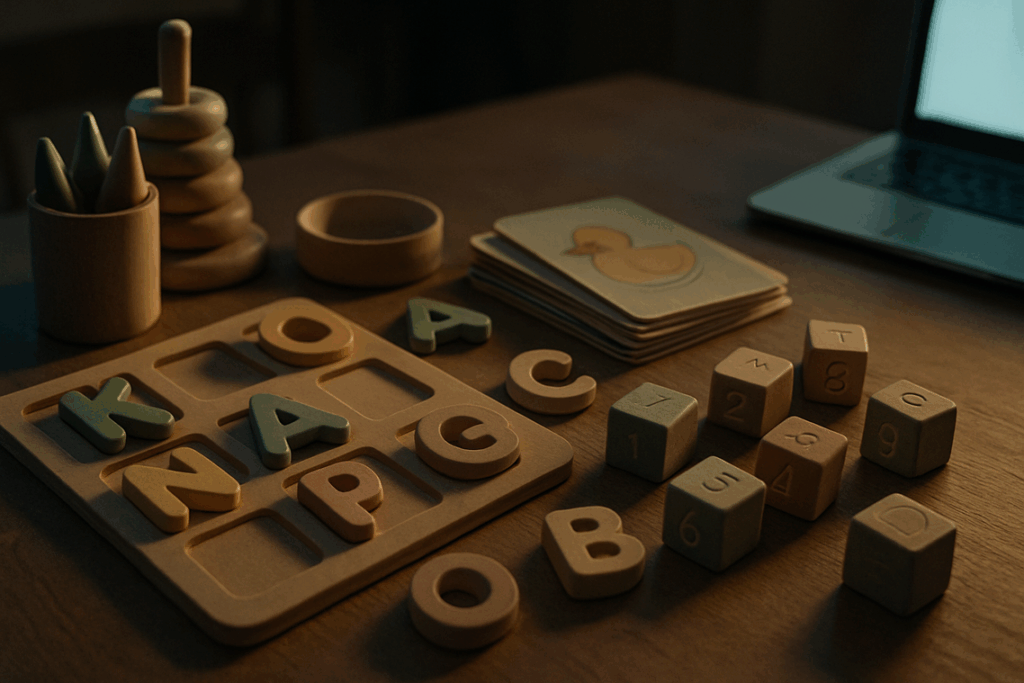
Bright plastic triangles clicking into place or wooden blocks wobbling before they tumble teach cause-and-effect (drop it, it falls—again and again). As toddlers rotate shapes to make them fit, they build spatial awareness, or understanding how objects relate in space. Some argue free play alone is enough. Yet guided cognitive development activities for kids like these gently introduce problem-solving skills without pressure (think of it as baby engineering).
Activity 2 – “I Spy” with Colors and Shapes
Next, try “I spy something red!” Watch their eyes scan the room. This simple game sharpens observation, attention span, and vocabulary. It also supports encouraging language growth through everyday conversations.
Activity 3 – Storytelling with Picture Books
Finally, while flipping thick board-book pages, ask, “What happens next?” Predictive thinking—guessing future outcomes—boosts memory recall and imagination. Pro tip: pause long enough to let them answer (even if it’s just an excited squeal).
Growing Minds: Engaging Activities for Preschoolers (Ages 3–5)
Last year, while waiting out a rainy afternoon in a tiny rental apartment, I watched a four-year-old turn a couch cushion into a “thinking island.” Every toy had to be sorted before it could “sail away.” That small moment captured something important: between ages three and five, children shift from simple exploration to deeper logic and reasoning. They begin asking “why” (on repeat), spotting patterns, and testing rules. According to the CDC, this stage often includes improved problem-solving and curiosity about how things work (CDC, 2023).
Activity 1 – Simple Puzzles & Memory Games
Matching pairs or completing a 12-piece puzzle may seem basic, but these games strengthen short-term memory (the brain’s ability to hold small bits of information briefly) and pattern recognition. For example, flipping cards to find matching animals trains focus and recall. Pro tip: Start with fewer pieces and gradually increase difficulty to avoid frustration.
Activity 2 – “What Doesn’t Belong?”
Present four items—three fruits and one shoe, for instance—and ask which doesn’t belong. This builds categorization (grouping similar items) and logical reasoning. At first, answers might be delightfully random (the shoe is “lonely”), but over time, reasoning sharpens.
Activity 3 – Cooking and Measuring
Following a simple recipe teaches sequencing (understanding order), early math concepts like counting cups, and listening skills. When a child cracks an egg before stirring, they’re practicing structured thinking—arguably the tastiest of cognitive development activities for kids.
Activity 4 – Building Forts
Finally, fort-building encourages planning, basic engineering, and imaginative play. Draping blankets over chairs requires trial and error (and patience). In other words, it’s preschool logic wrapped in a superhero cape.
Brain Boosts On-the-Go: Adapting Activities for Travel
Travel days can test everyone’s patience. Screens feel like the easiest fix (and sometimes they are), but research shows that active engagement strengthens memory, language, and problem-solving skills far more effectively than passive viewing (American Academy of Pediatrics, 2016). The trick is packing cognitive development activities for kids that work in tight spaces.
Travel-Friendly Brain Games
‘I Spy’—Road Trip Edition
Swap household objects for clouds shaped like animals, highway signs, or items pulled from a backpack. This simple game builds visual discrimination and attention control—two skills linked to early reading success (National Early Literacy Panel, 2008).
The Alphabet Game
“I’m going on a trip and I’m bringing an… Apple.” Each player adds a letter. It strengthens working memory—the brain’s sticky note system (yes, even adults drop theirs sometimes)—and reinforces letter sequencing.
Magnetic Puzzles & Tangrams
Compact sets reduce mess while boosting spatial reasoning. Studies show spatial play supports later math achievement (Verdine et al., 2014). Small pieces, big brain gains. Pro tip: Choose sets with a built-in tray.
Audiobooks & Story Podcasts
Listening comprehension increases vocabulary exposure beyond everyday conversation (Logan et al., 2019). On long drives or flights, stories fuel imagination—no Wi-Fi required (a parenting win).
Making Learning a Lifelong Adventure
Fostering cognitive growth doesn’t require flashcards or formal lessons. Instead, it grows from simple, consistent, playful interaction—counting shells at the beach, telling stories on the bus, asking “why” one more time. The goal isn’t to be a teacher; it’s to be an engaged parent who turns ordinary moments into small discoveries.
You might be wondering, what’s next? Start small. Choose one activity from this list and try it this week. Then repeat. Over time, these tiny habits compound (like interest in a savings account). Consistency with cognitive development activities for kids creates lasting impact everywhere.
Traveling with your children doesn’t mean putting their growth on pause. You set out looking for practical ways to balance adventure with stability, learning, and connection—and now you have the tools to do exactly that. From building flexible routines to weaving cognitive development activities for kids into everyday travel moments, you’re equipped to turn every trip into a meaningful learning experience.
The real challenge isn’t whether you can travel with kids. It’s how to do it without feeling overwhelmed, unprepared, or worried that they’re missing out on structure and development. With the right strategies, travel becomes an advantage—not a setback—for your child’s confidence, curiosity, and emotional growth.
Incorporating simple cognitive development activities at home not only enhances your child’s learning but also prepares them for engaging experiences during family trips, making it easier to create a flexible travel schedule with children – for more details, check out our Creating a Flexible Travel Schedule with Children.
Keep Growing While You Go
Don’t let uncertainty hold your family back from exploring the world. If you want practical, real-world strategies that make traveling with kids smoother, smarter, and more enriching, start applying these techniques on your very next trip. Families everywhere are transforming chaotic travel into connected, growth-filled experiences—now it’s your turn. Plan intentionally, stay consistent, and make every journey count.
 Child Development & Nomadic Lifestyle Advisor
There is a specific skill involved in explaining something clearly — one that is completely separate from actually knowing the subject. Madeleine Klecknerona has both. They has spent years working with helpful reads in a hands-on capacity, and an equal amount of time figuring out how to translate that experience into writing that people with different backgrounds can actually absorb and use.
Madeleine tends to approach complex subjects — Helpful Reads, Daily Parenting Highlights, Child Development Strategies being good examples — by starting with what the reader already knows, then building outward from there rather than dropping them in the deep end. It sounds like a small thing. In practice it makes a significant difference in whether someone finishes the article or abandons it halfway through. They is also good at knowing when to stop — a surprisingly underrated skill. Some writers bury useful information under so many caveats and qualifications that the point disappears. Madeleine knows where the point is and gets there without too many detours.
The practical effect of all this is that people who read Madeleine's work tend to come away actually capable of doing something with it. Not just vaguely informed — actually capable. For a writer working in helpful reads, that is probably the best possible outcome, and it's the standard Madeleine holds they's own work to.
Child Development & Nomadic Lifestyle Advisor
There is a specific skill involved in explaining something clearly — one that is completely separate from actually knowing the subject. Madeleine Klecknerona has both. They has spent years working with helpful reads in a hands-on capacity, and an equal amount of time figuring out how to translate that experience into writing that people with different backgrounds can actually absorb and use.
Madeleine tends to approach complex subjects — Helpful Reads, Daily Parenting Highlights, Child Development Strategies being good examples — by starting with what the reader already knows, then building outward from there rather than dropping them in the deep end. It sounds like a small thing. In practice it makes a significant difference in whether someone finishes the article or abandons it halfway through. They is also good at knowing when to stop — a surprisingly underrated skill. Some writers bury useful information under so many caveats and qualifications that the point disappears. Madeleine knows where the point is and gets there without too many detours.
The practical effect of all this is that people who read Madeleine's work tend to come away actually capable of doing something with it. Not just vaguely informed — actually capable. For a writer working in helpful reads, that is probably the best possible outcome, and it's the standard Madeleine holds they's own work to.