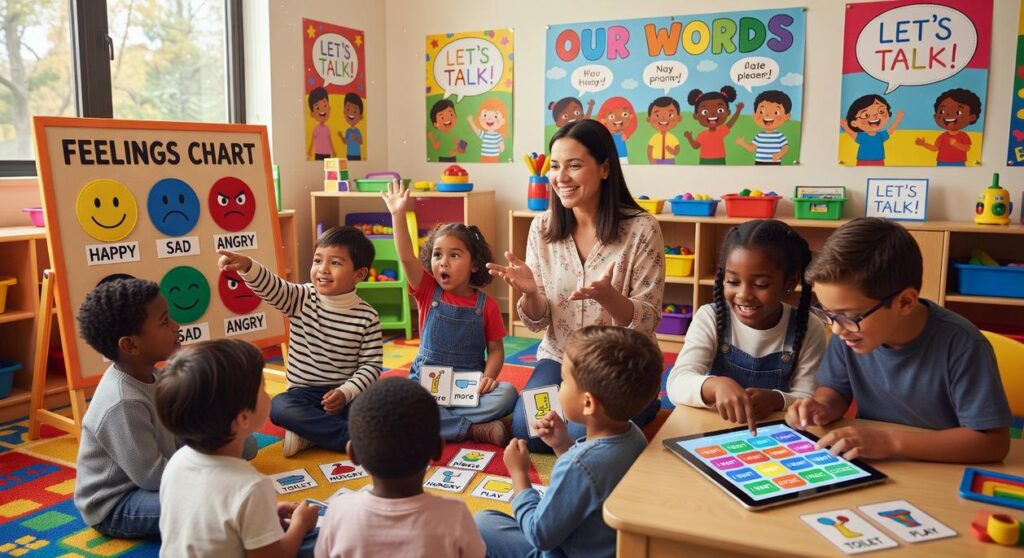
Your home is more than just a place to eat and sleep—it’s the most powerful classroom your child will ever have. If you’ve been searching for simple, effective ways to boost your child’s communication skills, you’re in the right place. This guide shows you how everyday routines—mealtime chats, bath time giggles, and bedtime stories—naturally turn into opportunities for supporting language development at home. You don’t need expensive toys or complicated programs. Drawing on practical, evidence-based child development strategies, we’ll share easy, age-appropriate ideas you can start using today to help your child grow into a confident communicator.
The Foundation: Creating a Language-Rich Environment
Building a strong communication base starts with intentional, everyday interaction. The goal isn’t perfection; it’s consistency.
-
Narrate Your World. Think of yourself as a friendly sportscaster for daily life. “I’m slicing the red apple for our snack.” “You’re stacking the big, blue blocks!” This technique—often called self-talk and parallel talk—exposes children to context-rich vocabulary tied to real actions. Research from Harvard’s Center on the Developing Child shows that responsive, back-and-forth exchanges strengthen neural connections for language (https://developingchild.harvard.edu/). The benefit? Words stick because they’re attached to lived experiences.
-
Embrace the Pause. After you speak, wait 5–10 seconds. This deliberate silence supports processing time and teaches conversational rhythm. (Yes, it can feel awkward—but growth often hides in quiet moments.) Over time, children begin filling that pause themselves.
-
Follow Their Gaze. Joint attention—when you talk about what your child is already focused on—dramatically improves engagement. If they’re watching a dog, describe the wagging tail or fluffy fur. Relevance fuels retention.
These simple habits form the backbone of supporting language development at home, turning ordinary routines into powerful learning opportunities.
Mealtime Chatter: Move beyond “here comes the airplane.” Talk about the food’s properties. Is it warm or cold? Mushy or crunchy? Sweet or savory? Use simple, repetitive phrases like “More banana?” or “All done milk.” Some parents argue that babies this young won’t understand, so why narrate lunch like a cooking show? But research shows that frequent, responsive talk builds early vocabulary and comprehension skills (Harvard Center on the Developing Child). Even if your child can’t answer yet, they’re absorbing patterns (tiny data scientists in bibs). Pro tip: pause after a question to give them a chance to babble back.
Bath Time Banter: The bathroom is a fantastic sensory classroom. Name body parts as you wash them (“Let’s wash your tiny toes”). Talk about the water (“The water is warm and splashy!”) and the toys (“The duck is floating!”). Some caregivers prefer quiet baths to avoid overstimulation. Fair point. But calm, descriptive language actually helps children connect words to sensations in real time. That’s powerful for supporting language development at home.
Getting Dressed Dialogue: Turn a daily chore into a learning moment. Label each piece of clothing as you put it on. Use descriptive words (“Let’s put on your soft, fuzzy socks”) and simple concepts like “in,” “on,” and “off.” Yes, it may feel repetitive. That’s the point. Repetition wires the brain for meaning (American Academy of Pediatrics).
Book Time — Not Just Story Time: Focus on interaction over narrative. Point to pictures and name them. Make animal sounds. Use an expressive voice. Let your child turn pages out of order (control is thrilling at this age). Engagement beats perfection every time.
Nurturing Conversation with Preschoolers (Ages 3–5)

Preschoolers are natural talkers—yet meaningful conversation doesn’t just “happen.” It’s built through small, everyday moments. At ages three to five, children rapidly develop vocabulary, grammar, and storytelling skills. However, many parents wonder: Do simple chats really make a difference? Research says yes—responsive back-and-forth conversation strengthens language pathways in the brain (Harvard Center on the Developing Child).
Turning Everyday Moments into Language Lessons
First, invite your child to be your “little helper.” While cooking or sorting laundry, ask open-ended questions—meaning questions that require more than a yes or no. For example, “What should we add next?” or “Why are these socks wet?” Open-ended questions encourage reasoning and longer responses (even if the answer is gloriously silly).
Next, shift from reader to storyteller. After finishing a favorite book, ask your child to retell it using the pictures. This builds narrative skills, or the ability to organize events into a clear story. You can also co-create tales: “Once upon a time, there was a purple dragon who loved to…” and let them continue. (Expect plot twists.)
Another powerful strategy is “expansion.” Expansion means repeating your child’s sentence while adding detail. If they say, “Doggie run,” respond with, “Yes, the big brown dog is running fast!” This models richer grammar without correcting them outright.
Finally, try simple problem-solving: “It’s raining—what could we do instead?” Hypothetical thinking strengthens critical language skills.
If you’re curious how play fits into all this, explore how play based learning supports early childhood development.
These small shifts make supporting language development at home both practical and powerful.
Parents often ask: What if my child points instead of talks? First, remember that pointing is communication. Especially in the toddler years, gestures often come months before clear words. After a few weeks of modeling language consistently, many children begin pairing gestures with sounds. So, acknowledge it and add the word: ‘You want more juice. Let’s get more juice.’
Likewise, should you correct mistakes? Rather than saying, ‘That’s not right,’ gently recast. If they say, ‘I goed to the park,’ respond, ‘You went to the park!’ This approach builds confidence while supporting language development at home over time with patience.
The Simple Magic of Daily Connection
As we’ve explored, fostering language isn’t about drills or flashcards—it’s about weaving conversation and connection into the fabric of your everyday life. If you’ve been feeling the pressure to “teach” your child, take a breath. The real growth happens in the small, natural moments you’re already sharing.
By narrating your day, playing together, and being fully present, you are supporting language development at home in the most meaningful way possible. That’s what your child truly needs.
Choose just one idea to try this afternoon. Start small, stay consistent, and watch how joyful interaction transforms your child’s confidence and communication.