
Parenting doesn’t pause for busy schedules, travel days, or overwhelming moments—and neither do your child’s big emotions. If you’ve ever wondered how to bring more calm into your family life without adding another complicated task to your to-do list, this guide is for you. We turn the abstract idea of mindfulness into simple, practical strategies that fit naturally into your daily routine. Rooted in child development principles and tested by real families, these mindful parenting practices help reduce stress, strengthen connection, and build resilience—so you can support your child’s growth anytime, anywhere.
The “Why” Behind the “How”: Mindfulness and the Developing Brain”
Incorporating mindful parenting practices into your daily routine not only enhances your connection with your child but also lays the groundwork for a stronger partnership, as explored in our Relationship Guide at Fpmomhacks – for more details, check out our Relationship Guide Fpmomhacks.
Mindfulness simply means paying attention on purpose, in the present moment. For children, that can be as basic as noticing their breath or how their feet feel on the floor. While some critics argue kids are “too young” for mindfulness (after all, isn’t sitting still hard enough?), research suggests otherwise: studies show mindfulness practices can improve emotional control and attention in children (Journal of Child and Family Studies, 2010).
Emotional Regulation in Real Life
First, try this: when your child starts to get upset, guide them through three slow breaths. Ask, “Where do you feel that feeling in your body?” This builds emotional regulation—the ability to manage big feelings before they explode into meltdowns. Over time, they learn to pause instead of react (a superpower for playground politics).
Next, strengthen focus with short “attention reps.” Set a one-minute timer and ask your child to listen carefully to every sound they hear. Gradually increase the time. Think of it as a workout for the brain’s attention system.
Then, build empathy by asking reflective questions: “How do you think your friend felt?” This nurtures awareness beyond themselves.
Used consistently, mindful parenting practices become more than a calming trick. They’re a lifelong tool—helping children grow into focused, compassionate, emotionally steady adults.
Mindfulness in Minutes: 5 Simple Practices for Any Age
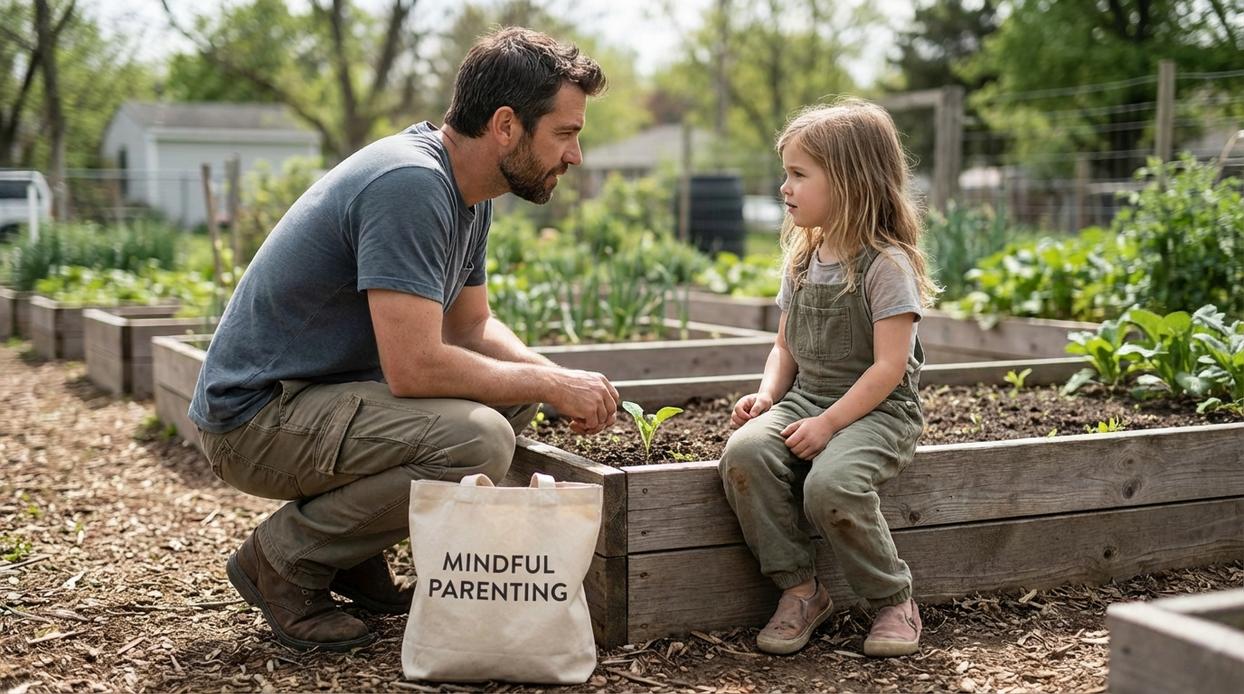
You don’t need a meditation cushion, a silent room, or an hour of free time to practice mindfulness. These five exercises are simple, portable, and designed for real life (yes, even the back seat of a car).
1. The Breathing Buddy (Ages 3–7)
Have your child lie down and place a small stuffed animal on their belly. Ask them to watch it rise and fall as they breathe in and out.
Steps:
- Inhale slowly through the nose for 3 counts.
- Exhale gently through the mouth for 3 counts.
- Repeat 5–10 times.
The visible movement turns an abstract concept—breathing—into something concrete. Research shows slow breathing can reduce stress and improve emotional regulation (Harvard Health Publishing, 2020). Pro tip: call it a “belly ride” to keep it playful.
2. The “Spy Senses” Walk
Turn any short walk into a sensory game.
5-4-3-2-1 Method:
- 5 things you see
- 4 things you hear
- 3 things you feel
- 2 things you smell
- 1 thing you taste
This builds attention control—a core executive function skill (Center on the Developing Child, Harvard University). Bonus: it transforms “Are we there yet?” into curiosity.
3. Mindful Snacking
Choose one small bite of food. Pause.
Notice the smell, texture, temperature, and taste before swallowing. One bite can become a full sensory experience. This practice encourages slower eating and better digestion (Mayo Clinic, 2021). It’s surprisingly powerful for both kids and adults.
4. The “Weather Report” Check-In
Ask: “What’s your weather inside right now?” Sunny? Cloudy? Stormy?
Naming emotions without judgment supports mindful parenting practices and strengthens emotional literacy. (Feelings aren’t bad weather—they just pass.)
5. Listening to the Bell
Ring a bell or tap a glass. Sit quietly until the sound completely fades.
This sharpens focus and eases transitions between activities. In chaotic moments, it’s like hitting a reset button—simple, structured, effective.
Making It Stick: Weaving Mindfulness into Your Daily Rhythm
Building calm into family life doesn’t require a retreat in the mountains. Instead, it works best when layered into what you’re already doing. That’s how habits stick (and how parents stay sane).
Morning Moments. Before your feet hit the floor, take three slow breaths. Inhale through the nose, exhale through the mouth. This tiny ritual signals safety to the nervous system, which research shows can lower cortisol levels (American Psychological Association). I recommend modeling this for your kids—no lecture required. They’ll follow your lead.
Mealtime Reset. Next, use the first minute of any meal for quiet, mindful eating. Notice texture, temperature, taste. It may feel awkward at first (silence can be loud), but it sets a calmer tone for the rest of dinner.
The After-School Transition. Similarly, try a five-breath reset in the car or at the front door. This creates a buffer between school stress and home life. Think of it as an emotional coat rack—hang up the day before stepping inside.
Bedtime Wind-Down. Finally, choose a simple body scan or “three good things” gratitude ritual. Gratitude practices are linked to improved sleep quality (Harvard Health Publishing).
If you’re already balancing work and family life practical daily parenting habits, layer these mindful parenting practices into those rhythms. Start small. Stay consistent. That’s the real magic.
What If My Child Won’t Sit Still?
If this sounds familiar, you’re not alone. Back in 2020, many parents tried short focus games during long days at home and discovered something surprising: progress happened in seconds, not hours.
Problem: “They get bored.” Keep it to 30–60 seconds and turn it into a race or silly challenge.
- Problem: “They can’t stop wiggling.” Remind them noticing wiggles is the goal; movement counts in mindful parenting practices.
Problem: “I feel silly doing it.” After a few weeks, most parents report joining in builds confidence—for both of you.
Small steps create lasting habits.
Building a Foundation of Presence, One Breath at a Time
You came here looking for a realistic way to support your child’s growth without adding more pressure to your already full days. Now you can see that mindful parenting practices don’t require perfect silence or extra hours—just small, intentional moments woven into the life you’re already living.
The real challenge isn’t loving your child—it’s staying calm and connected in the middle of the chaos. One shared breath, one pause, one gentle check-in can shift the tone of your entire day.
Start today. Choose one simple practice and try it during your next routine moment. Small steps build lasting presence—and that presence is what your child will carry for life.
 Child Development & Nomadic Lifestyle Advisor
There is a specific skill involved in explaining something clearly — one that is completely separate from actually knowing the subject. Madeleine Klecknerona has both. They has spent years working with helpful reads in a hands-on capacity, and an equal amount of time figuring out how to translate that experience into writing that people with different backgrounds can actually absorb and use.
Madeleine tends to approach complex subjects — Helpful Reads, Daily Parenting Highlights, Child Development Strategies being good examples — by starting with what the reader already knows, then building outward from there rather than dropping them in the deep end. It sounds like a small thing. In practice it makes a significant difference in whether someone finishes the article or abandons it halfway through. They is also good at knowing when to stop — a surprisingly underrated skill. Some writers bury useful information under so many caveats and qualifications that the point disappears. Madeleine knows where the point is and gets there without too many detours.
The practical effect of all this is that people who read Madeleine's work tend to come away actually capable of doing something with it. Not just vaguely informed — actually capable. For a writer working in helpful reads, that is probably the best possible outcome, and it's the standard Madeleine holds they's own work to.
Child Development & Nomadic Lifestyle Advisor
There is a specific skill involved in explaining something clearly — one that is completely separate from actually knowing the subject. Madeleine Klecknerona has both. They has spent years working with helpful reads in a hands-on capacity, and an equal amount of time figuring out how to translate that experience into writing that people with different backgrounds can actually absorb and use.
Madeleine tends to approach complex subjects — Helpful Reads, Daily Parenting Highlights, Child Development Strategies being good examples — by starting with what the reader already knows, then building outward from there rather than dropping them in the deep end. It sounds like a small thing. In practice it makes a significant difference in whether someone finishes the article or abandons it halfway through. They is also good at knowing when to stop — a surprisingly underrated skill. Some writers bury useful information under so many caveats and qualifications that the point disappears. Madeleine knows where the point is and gets there without too many detours.
The practical effect of all this is that people who read Madeleine's work tend to come away actually capable of doing something with it. Not just vaguely informed — actually capable. For a writer working in helpful reads, that is probably the best possible outcome, and it's the standard Madeleine holds they's own work to.